

 Skip to content
Home » Food Production
Air management plays a fundamental role in modern food manufacturing environments. Production facilities must maintain strict environmental conditions to protect ingredients, processing lines, and packaging operations from contamination risks. While sanitation procedures and surface controls are well established in food safety programs, airborne contaminants remain a complex challenge for engineers and facility managers.
Air circulation can transport microbial particles, dust, and aerosols across different production zones. Without engineered control strategies, contaminants generated during mixing, cutting, conveying, or packaging operations may travel through ventilation systems and settle on surfaces or exposed products.
Understanding how air pollution affects food production is, therefore, critical when designing facility infrastructure. Air treatment technologies integrated with HVAC systems help facilities maintain stable environmental conditions while supporting regulatory compliance and operational efficiency.
Air Sniper manufactures UV-C supplemental air purification systems designed for industrial-scale applications. These systems combine ultraviolet germicidal irradiation with durable engineering to continuously reduce airborne contaminants while maintaining energy efficiency and long service intervals.
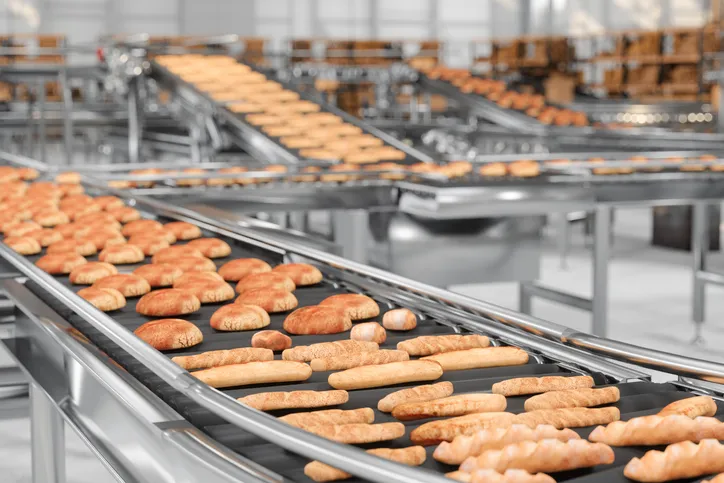
Maintaining proper air quality standards in food production areas is essential for protecting product integrity and ensuring regulatory compliance. Food processing facilities handle raw ingredients that may naturally contain microorganisms or particulates. When these materials are processed, airborne particles can become suspended in the surrounding environment.
If airflow patterns are not carefully controlled, these particles may move between processing zones, ingredient handling areas, and packaging lines.
For example, powdered ingredients such as flour, sugar, or spices can generate airborne dust during mixing or transfer processes. These particles may remain suspended in air currents and travel through ventilation systems before settling elsewhere in the facility.
Air management strategies, therefore, focus on controlling airflow direction, maintaining pressure differentials between zones, and ensuring that circulating air is continuously treated.
Engineering teams responsible for environmental control typically consider several operational objectives:
| Environmental Control Objective | Operational Impact |
|---|---|
| Airflow direction and pressure management | Limits the movement of contaminants between production zones |
| Continuous air treatment | Reduces the accumulation of airborne microbial particles |
| HVAC coil maintenance | Maintains energy efficiency and airflow performance |
| Scalable purification systems | Allows treatment in both large production halls and localized spaces |
| Monitoring and automation | Enables facility managers to track performance through building systems |
These engineering controls work together to maintain consistent environmental conditions while supporting food safety programs and regulatory expectations.
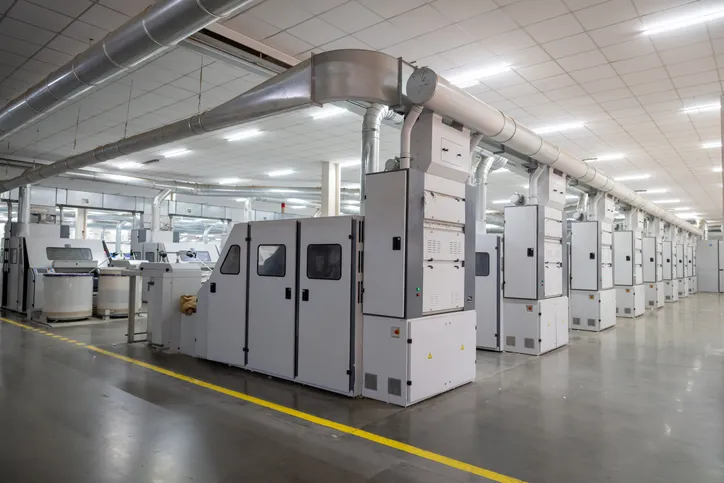
Air pollution within a food manufacturing facility refers to airborne contaminants that may influence product quality, equipment performance, or environmental stability. These contaminants can originate from raw materials, production processes, packaging operations, or outdoor air entering the building.
Particles generated during food processing often become suspended in air currents and circulate through ventilation systems. Over time, these particles may deposit onto processing equipment, conveyor belts, or packaging surfaces.
Environmental fluctuations caused by airborne particles may also affect shelf stability or production consistency. Facilities that implement air treatment strategies designed to continuously reduce airborne contaminants are better positioned to maintain controlled environmental conditions.
Food manufacturing environments contain a wide range of airborne particles generated during daily operations.
Examples include:
These contaminants can remain airborne for extended periods depending on airflow patterns and particle size. Once airborne, they may travel through ducts and ventilation systems, spreading across multiple areas of the facility.
HVAC systems provide temperature control, humidity management, and ventilation in food manufacturing facilities. Engineers responsible for food production air conditioning must design systems that balance environmental stability with contamination control.
Airflow patterns are particularly important. Production areas handling sensitive ingredients or final packaging often operate under positive pressure conditions to limit contaminant migration from adjacent spaces.
However, HVAC equipment itself can become a source of contamination if components accumulate organic buildup. Cooling coils, ducts, and air handling units may collect particles over time, which can influence airflow efficiency and environmental stability.
To address these challenges, many facilities integrate ultraviolet germicidal irradiation (UVGI) into their HVAC infrastructure. UV-C energy is applied within ductwork or near coil surfaces to support continuous air treatment.
Air Sniper systems are designed to integrate directly into HVAC infrastructure, allowing facilities to introduce supplemental purification without restricting airflow or requiring extensive system modifications.
Food manufacturing facilities typically use a combination of centralized and localized air treatment systems.
Centralized systems installed within ductwork treat air as it moves through HVAC infrastructure, helping manage contaminants circulating throughout the building. Localized systems provide additional coverage in areas with higher contamination risk or limited ventilation.
Air Sniper develops several product configurations to support this layered approach to air management.
The Air Sniper Induct 300W system is designed to install directly within existing HVAC ducts. Equipped with a 300-watt UV lamp, the unit activates when airflow is detected. This ensures energy is only used when the ventilation system is operating.
These systems are engineered for industrial environments and feature:
Long lamp life significantly reduces maintenance requirements compared with conventional UV systems that require annual replacement.
Yes. Many modern air treatment systems are designed for modular deployment, allowing facilities to address airborne contamination challenges without redesigning their HVAC infrastructure.
Air Sniper provides both integrated and portable systems to support flexible deployment strategies.
The Air Sniper Spectrum 800 is a portable stand-alone unit that can be placed in areas requiring additional air treatment. The unit operates quietly and connects via Bluetooth, allowing operators to monitor and control system performance remotely.
Because the system requires no installation, it can be relocated to different workspaces depending on production requirements.
For smaller areas, the Air Sniper Low Pro system provides continuous supplemental protection by maximizing UVGI output while maintaining the dwell time necessary for effective air treatment.
These modular solutions allow facilities to deploy supplemental purification in targeted areas such as packaging rooms, storage areas, or processing lines.
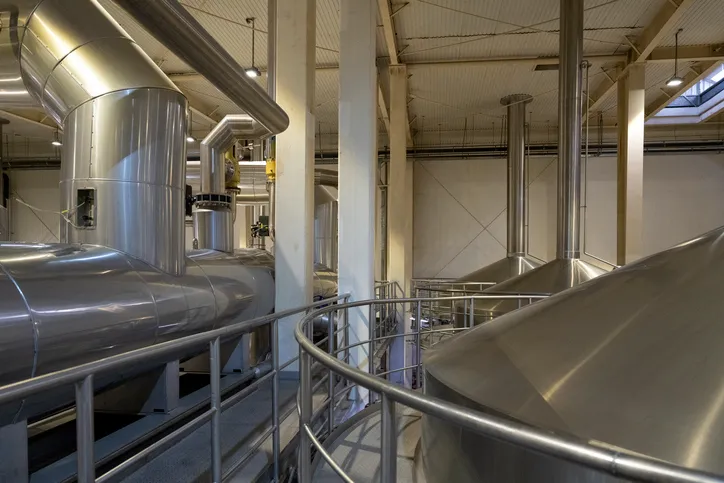
Another challenge in food processing HVAC systems involves organic buildup on cooling coils. Over time, dust, moisture, and biological particles can accumulate on coil surfaces, reducing heat transfer efficiency and increasing system energy demand.
The Air Sniper 300W CC GEN II coil irradiation system addresses this issue by continuously exposing coil surfaces to UV-C energy.
This approach helps prevent the accumulation of organic material that can interfere with airflow and thermal performance.
With a lamp lifespan exceeding 55,200 hours, the system operates for more than six years without requiring replacement. This extended service interval reduces maintenance requirements while helping HVAC systems maintain consistent performance.
Maintaining coil cleanliness is particularly important in large production facilities where HVAC systems operate continuously, and energy consumption represents a high operational cost.
Maintaining reliable environmental control requires a combination of airflow management, filtration, and supplemental air treatment technologies. Engineers responsible for facility design must evaluate how air moves through production areas and how airborne particles may influence food safety and operational performance.
Understanding how air pollution affects food production allows facilities to implement targeted engineering controls that support contamination management without increasing operational complexity.
Air Sniper systems provide scalable UV-C supplemental purification designed for industrial environments. With in-duct systems, portable units, and coil irradiation solutions, facilities can implement layered air treatment strategies that continuously reduce airborne contaminants while maintaining energy efficiency.
By combining advanced HVAC integration with long-life UV-C technology, facilities can maintain reliable air quality standards in food production areas while supporting operational efficiency and long-term cost control.
Many particles generated during food processing are extremely small and remain suspended in the air for extended periods. Activities such as mixing powders, conveying ingredients, or packaging products can release particles that travel through ventilation systems and production spaces.
Yes. HVAC systems designed for food production air conditioning can help manage contamination risks by regulating airflow direction, temperature stability, and humidity levels. Proper system design ensures that clean production areas maintain appropriate pressure and airflow control relative to surrounding spaces.
Air exchange rates determine how frequently the air within a room is replaced or treated. Higher air exchange rates can help manage airborne particles generated during production processes, especially in areas with high levels of activity or ingredient handling.